


There are places that live many lives. Plage Paloma is one of them.
Tucked below the cliffs of Saint-Jean-Cap-Ferrat, the cove first showed itself to me as a glorious restaurant — all classic Mediterranean food, a transeat in the shade, the kind of afternoon nap you earn after a plate of grilled fish and a cold rose. And then the light. Every evening it projected something extraordinary onto the limestone cliffs looking out toward Eze and beyond — gold bleeding into pink bleeding into something that had no name but made you stop whatever you were saying mid-sentence.
A Place That Has Come Full Circle
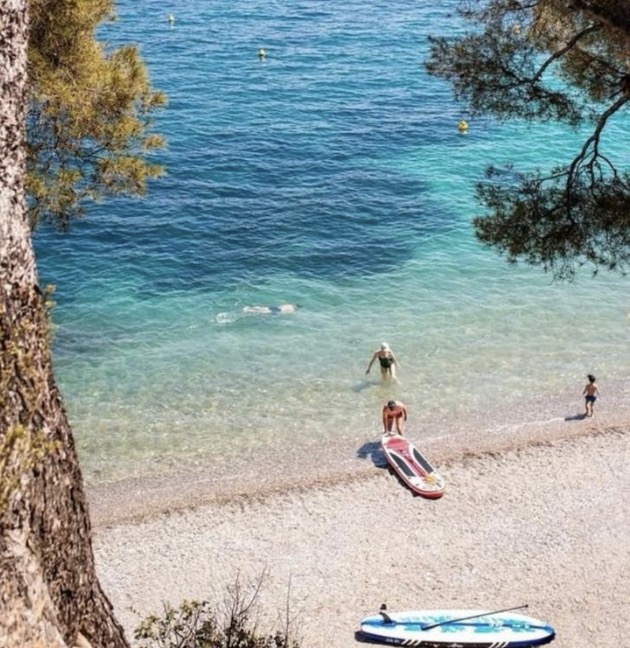
Looking down on Plage Paloma, Saint-Jean-Cap-Ferrat
Things change. The restaurant is gone now. What remains is the beach — the sand, the sea, the pines arching overhead, the turquoise water that turns almost translucent at the edges. In some ways it is more itself than it ever was. Strip away the white tablecloths and the clink of glasses, and what you have left is something ancient and uncomplicated. A cove. A shore. An invitation to do nothing useful.
I painted this from above, standing on the cliff path that winds along the top of the headland. From up there you get the full picture — the way the beach sits cupped between the rocks, the way the water graduates from pale mint near the shore to something deeper and more serious further out. A solitary figure at the water’s edge. Two swimmers. A small boat resting on the sand like it had nowhere urgent to be.
Why I Paint These Places
I use watercolor for the South of France because it behaves the way memory does. It bleeds. It softens edges. It refuses to hold every detail, so it forces you to choose what actually mattered.
What mattered here was the light on the limestone. The green of the Aleppo pines against the blue. That particular shade of cerulean that the Mediterranean reserves for windless Saturday mornings. And the feeling — which I suspect anyone who has ever stood at the edge of that cove knows — that this small patch of earth has been absorbing human joy and human stillness for a very long time, and will go on doing so long after we have moved on.
The restaurant changed the place. Losing the restaurant changed it again. And now Plage Paloma is just a beach. Aren’t we all?
Painting the French Riviera
Saint-Jean-Cap-Ferrat is one of those places that resists being painted well. It is almost too beautiful — the kind of place where a bad painting would be an insult to the subject. The light is relentless and specific. The water has opinions about color. The pines throw shadows that move faster than you expect.
But Plage Paloma from above gives you a composition that almost arranges itself. The framing branches. The diagonal of the shoreline. The scattered figures small enough to suggest without rendering. I worked quickly — plein air always demands that — and let the watercolor find its own way into the crevices.
Sometimes the best thing you can do is set up, get out of the way, and let the place tell you what it wants to be.
A Question Worth Sitting With
There is something in the way places cycle through their incarnations — restaurant, beach, ruin, park, something new — that mirrors the way we move through our own lives. We accumulate identities, shed them, and eventually find out what we actually are underneath.
I keep returning to the French Riviera not for the glamour — though that exists, and is not unpleasant — but because it is very good at reminding me that things come and go, and what remains when they do is usually the essential thing.
What place keeps calling you back? And do you know yet what it is really trying to show you?
FAQ: Plage Paloma and Painting the French Riviera
Where exactly is Plage Paloma?
Plage Paloma is a small, sheltered cove on the Cap Ferrat peninsula in the South of France, near Saint-Jean-Cap-Ferrat. It sits below limestone cliffs with views toward Eze and the hills beyond Monaco. Access is on foot — no vehicles — which keeps it from being overrun.
What watercolor techniques work best for Mediterranean scenes?
Wet-on-wet for the sky and water — let the colors bleed into each other rather than fighting for hard edges. For the limestone, dry brushwork picks up texture naturally. Work fast, especially in direct sun, because the paint dries before you expect. Limit your palette: cerulean, raw sienna, sap green, and a touch of burnt umber handles most of what the Riviera throws at you.
Is Plage Paloma good for plein air painting?
Excellent — with caveats. The cove itself gets crowded in high summer; painting from the cliff path above gives you better composition and more breathing room. Morning light before 10am is ideal. Bring sun protection — the limestone reflects heat aggressively, and you will be more focused on the painting than on how burnt your forearms are getting.
Where can I see more of Miles’s French Riviera watercolors?
On Instagram at miles.spencer.artist and on Facebook at Miles Spencer Artist. New work goes up regularly, particularly after painting trips to the South of France.
About the Artist
Miles Spencer is an entrepreneur, author, and watercolor artist based in Connecticut. He paints the South of France for an audience of Americans who love the region — its light, its unhurried rhythms, and the particular way it makes ordinary afternoons feel significant. His novels include A Line in the Sand and Havana Famiglia (co-written with Wells Jones). He is also the CEO and Co-Founder of Reflekta.ai, an AI platform for intergenerational storytelling and legacy.
Follow along on Instagram at miles.spencer.artist or explore his writing on Amazon.