

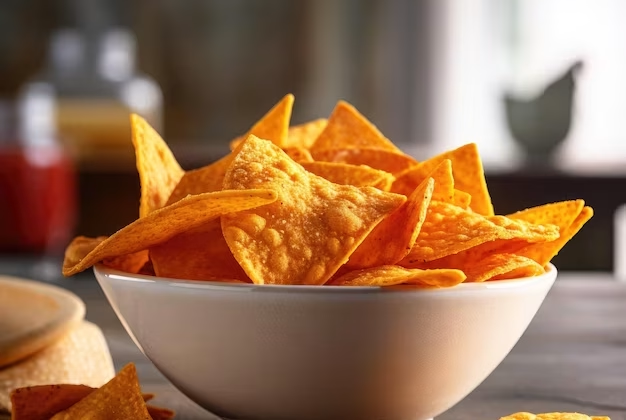
Snack-Sized Media: The Dorito Effect on Our Minds
Bo Burnham hit the nail on the head when he likened social media to a colonizer of attention. In a 2019 panel, the comedian-musician observed,
“Social media firms are] coming for every second of your life… Their entire model is growth.”
Since then, platforms like TikTok have perfected this conquest with algorithmic precision, creating an endless buffet of dopamine-fueled bites that keep us scrolling long past reason. Burnham’s words ring louder in the TikTok era, where average daily app use rivals full-length movies: TikTok users clock in at 95 minutes a day, YouTube at 74 minutes, and Instagram at 51 minutes.
This “snackable” media phenomenon isn’t just a coincidence; it’s engineered. Eugene Wei, a tech commentator, attributes TikTok’s runaway success to its “algorithm-friendly design”—single-video scrolling that serves as a Petri dish of user preference. Unlike traditional social feeds, TikTok’s precise signals (view duration, replays, and shares) feed a relentless loop of better recommendations. It’s like a Dorito chip—scientifically optimized to keep you munching, but in this case, you’re consuming an unending stream of videos instead of nacho cheese dust.
The analogy holds disturbingly well. Doritos are a triumph of food science, maximizing flavor impact per crunch. Similarly, TikTok distills entertainment into 15-second bursts that deliver instant gratification. Burnham’s observation that these companies are colonizing attention underscores the stakes: we’re trading deep engagement for fleeting stimulation.
Even TikTok admits to its addictive potential. Internal documents suggest it takes just 260 videos—or 35 minutes—to hook an average user. This algorithmic efficiency has transformed not just TikTok, but the entire media landscape. YouTube’s Shorts, Instagram’s Reels, and even Snapchat’s Spotlight mimic TikTok’s design, competing for slices of our attention span.
This model works because it taps into primal brain functions. The speed and frequency of dopamine hits from short-form videos are rewiring how we process content, shortening attention spans and reducing our capacity for sustained focus. Where does it leave us? A generation adept at consuming content but less equipped for reflection or deeper learning.
The food analogy extends to content creators, too. MrBeast, YouTube’s most-followed creator, has built an empire by perfecting the recipe for viral videos. His leaked production memo shows his obsession with metrics like click-through rates and audience retention. Yet, even MrBeast is pulling back from the overstimulated chaos of his earlier work, advocating for storytelling and slower-paced content.
He’s onto something. While ultra-fast media has its place—like Doritos at a party—it shouldn’t dominate our intellectual diet. Long-form content, whether podcasts or books, offers the mental nourishment that short-form can’t. These mediums let us think, empathize, and connect in ways snack-sized media never will.
So, as we scroll through our feeds, let’s ask: are we snacking wisely, or letting algorithms dictate our mental diet? Like a bag of chips, short-form videos are irresistible in the moment but rarely satisfying in the long run. Balance is key—just don’t forget to savor the occasional book or podcast for the mental equivalent of a home-cooked meal.


